Choosing the right OEM Faucet Handle supplier in China requires more than comparing catalog prices. The supplier must control materials, tooling, plating, tolerances, and final inspection. A polished sample can still hide a weak cartridge fit or uneven chrome under warehouse lighting. That is where many buyers misjudge risk.
The U.S. Environmental Protection Agency’s WaterSense program reports that certified bathroom faucets use no more than 1.5 gallons per minute, compared with the federal maximum of 2.2 gallons. This matters because handle design affects user control, perceived quality, and compatibility with water-saving cartridges. Grand View Research also identifies replacement demand, renovation, and premium bathroom products as important faucet-market drivers. These trends make customization valuable, but they raise the need for dependable engineering and documentation.
David Kohler, chairman and CEO of Kohler Co., has said, “Design is not just what it looks like; design is how it works.” His point applies directly to OEM handles: a beautiful lever means little if it loosens after repeated use. Ask Chinese suppliers for alloy specifications, salt-spray results, cartridge-cycle testing, mold ownership terms, and inspection records. Request a pre-production sample before approving mass production. Check thread dimensions with calipers, not assumptions. Also verify whether quoted prices include tooling, packaging, spare parts, and corrective service. The weakest detail may become the loudest complaint. This guide examines supplier research, factory audits, sample evaluation, quality control, communication, and total landed cost. It also considers an uncomfortable truth: the cheapest offer may be expensive after rework, delays, and customer returns.
Sources: U.S. EPA WaterSense, Residential Faucet Specification; Grand View Research, Faucets Market Reports.
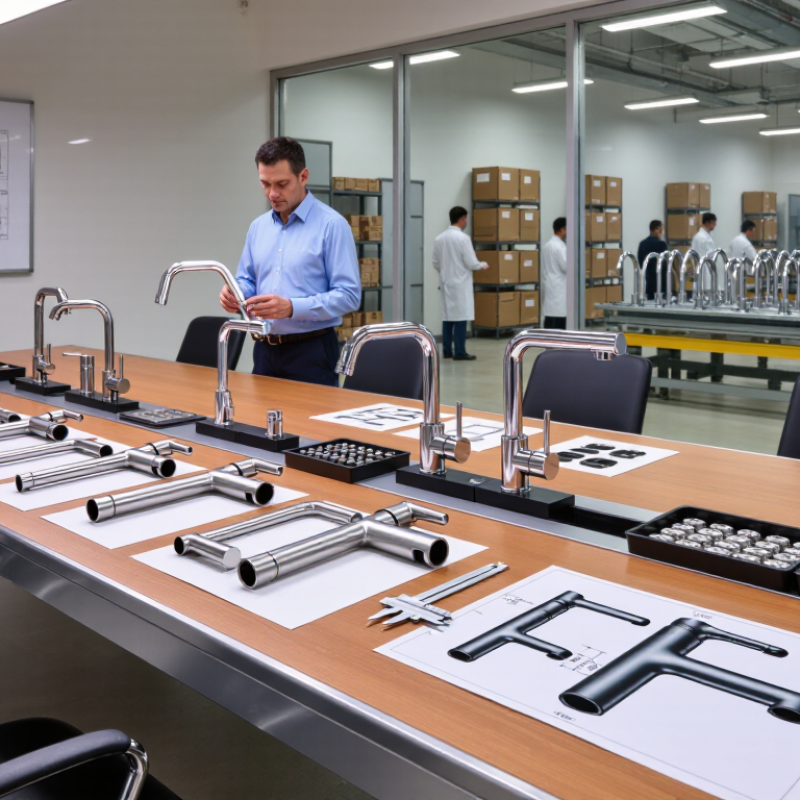
Define Your OEM Faucet Handle Requirements
Before searching for an OEM faucet handle supplier in China, define the product precisely. A vague request often produces inconsistent samples and delayed quotations. Prepare a drawing showing overall length, mounting-hole spacing, thread size, and acceptable tolerances. Include the handle’s intended faucet type and installation method. A supplier should not guess these details.
Specify the material, surface finish, color reference, and required weight. For example, state whether the handle uses brass, stainless steel, zinc alloy, or engineered plastic. Describe the finish as brushed, polished, matte, or another measurable surface. Request sample checks for scratches, plating adhesion, sharp edges, and fitting accuracy. Small defects become expensive when production reaches thousands of units.
Performance requirements need equal attention. Define the expected operating cycles, load resistance, corrosion testing, and temperature conditions. Mention packaging dimensions, individual protection, carton limits, and labeling needs. Ask for inspection records and a pre-production sample. We once approved a handle because its appearance was excellent, but its internal insert was too loose. That mistake was avoidable. Leave room for improvement. Your specification should identify what must never change, while allowing the supplier to suggest practical manufacturing adjustments.
Research Qualified Faucet Handle Suppliers in China
Finding a qualified faucet handle supplier in China requires more than comparing online catalogs. Check whether the supplier manufactures handles or only resells them. Request a business license, factory address, production photos, and recent export experience. A video tour can reveal equipment, storage conditions, and inspection procedures.
Ask for material details, such as brass grade, stainless steel type, surface treatment, and dimensional tolerances. Request samples before discussing large orders. Test the handle for smooth movement, thread accuracy, coating adhesion, and resistance to repeated use. Small defects matter. A loose screw can damage customer trust.
Review the supplier’s quality records and response time. Reliable suppliers explain inspection steps instead of promising perfect results. Consider an independent factory audit when the order value is significant. Confirm minimum order quantity, tooling ownership, packaging, lead time, and replacement terms in writing. Communication can still fail, even with a detailed checklist. Leave room for corrective actions. A polished showroom proves little without consistent sample quality and traceable production records.
How to Find the Best OEM Faucet Handle Supplier in China?
A structured supplier review should prioritize product quality, regulatory compliance, material consistency, production capability, commercial terms, delivery performance, and communication. The weighting below provides a practical framework for comparing qualified OEM faucet handle suppliers.
Quality and compliance receive the highest weighting because faucet handle suppliers should demonstrate consistent manufacturing control, suitable material documentation, reliable inspection procedures, and the ability to meet the buyer’s technical specifications. Use the categories to create a weighted scorecard after reviewing samples, certifications, factory evidence, and commercial terms.
Compare Pricing, Certifications, and Production Terms
Finding the best OEM faucet handle supplier in China requires more than comparing unit prices. Request a detailed quotation with material grade, finish, packaging, tooling, minimum order quantity, and shipping terms. A low price may exclude molds or export packaging. That omission can damage your real budget.
Certifications need careful checking. Ask for current certificates, issuing organizations, covered products, and expiration dates. Verify whether the certificate applies to the faucet handle, factory, or another product. Depending on your target market, request relevant material and safety documentation. Factory audits can also reveal plating conditions, storage practices, and quality controls. A clean document file is not enough.
Production terms often separate a reliable supplier from a risky one. Confirm sample approval, monthly capacity, inspection points, defect handling, lead time, and change-control procedures. Ask how the supplier manages color differences between batches. Also clarify warranty coverage and replacement responsibilities in writing. I would compare at least three quotations using the same specifications. Otherwise, the cheapest offer may simply be incomplete. A practical test order can expose weak packaging, uneven polishing, or slow communication. It may cost more initially. That lesson is easy to overlook.
How to Find the Best OEM Faucet Handle Supplier in China? - Compare Pricing, Certifications, and Production Terms
Anonymized supplier-profile benchmark for comparing OEM faucet handle manufacturers
The figures below are indicative China OEM market benchmarks for faucet handles and should be confirmed with technical drawings, material specifications, finish requirements, order quantity, and destination-market regulations.
| Supplier Profile |
Typical Product Focus |
Indicative Unit Price
(USD, EXW) |
Typical MOQ |
Tooling Cost Range |
Sample Lead Time |
Mass-Production Lead Time |
Certification and Quality Evidence to Request |
Typical Payment Terms |
Warranty and Claims Practice |
Best Fit |
Profile A
High-volume value supplier |
Zinc alloy or stainless-steel handles with standard plating, painting, or powder coating |
$1.20–$3.20 |
1,000–3,000 pcs per SKU |
$800–$2,500 |
7–15 days |
30–45 days after approval |
ISO 9001 certificate; material declaration; RoHS/REACH evidence where applicable; coating thickness, adhesion, salt-spray, and dimensional inspection reports |
30% deposit and 70% before shipment |
Usually 12 months for manufacturing defects; replacement or credit subject to inspection evidence |
Large retail programs and cost-sensitive standard designs |
Profile B
Mid-volume engineered supplier |
Brass, stainless steel, or zinc alloy handles with custom geometry and coordinated finishes |
$2.80–$6.80 |
500–1,500 pcs per SKU |
$1,200–$3,500 |
10–20 days |
35–50 days after approved sample |
ISO 9001; alloy composition or material test report; dimensional inspection; finish durability testing; product-specific potable-water reports when the handle is part of a regulated water-contact assembly |
30% deposit and 70% against pre-shipment inspection |
12–18 months; corrective-action report commonly provided for verified defects |
Brands requiring a balance of design flexibility, quality, and price |
Profile C
Low-MOQ customization supplier |
Small-batch custom handles, replacement parts, and mixed-SKU orders |
$4.50–$9.50 |
100–500 pcs per SKU |
$500–$2,000 |
5–12 days for samples or 3D-printed prototypes |
20–35 days after sample approval |
Verify factory audit records, material certificates, first-article inspection, finish samples, and independent test reports where required; do not rely only on supplier declarations |
50% deposit and 50% before shipment |
Typically 6–12 months; claims normally require photos, samples, or third-party inspection |
Start-ups, e-commerce sellers, pilot launches, and spare-parts programs |
Profile D
Premium integrated manufacturer |
Machined brass or stainless-steel handles with strict surface-finish and assembly requirements |
$6.50–$14.00 |
300–1,000 pcs per SKU |
$2,000–$6,000 |
15–25 days |
45–65 days after design and testing approval |
ISO 9001; traceable material certificates; documented process controls; first-article approval; independent laboratory reports for market-specific water-contact or chemical requirements |
30% deposit and 70% after final inspection |
12–24 months with formal corrective-action and batch-traceability procedures |
Premium hospitality, architectural, and specification-driven projects |
Supplier Selection Checklist
| Evaluation Dimension |
Recommended Verification |
Suggested Weight |
| Total landed cost |
Compare unit price, tooling, packaging, inspection, freight, duties, and potential rework costs. |
25% |
| Certification and compliance |
Check certificate scope, validity, issuing body, test method, product model, and destination-market applicability. |
20% |
| Production capability |
Confirm equipment, monthly capacity, subcontracted processes, capacity reservations, and quality-control checkpoints. |
20% |
| Lead time and delivery reliability |
Request a written schedule covering tooling, sampling, approval, production, inspection, and shipment. |
15% |
| Quality and after-sales response |
Define acceptance criteria, allowable defect levels, warranty period, claim evidence, replacement policy, and corrective-action timing. |
20% |
Important: ISO 9001 demonstrates a quality-management system, but it is not a product safety certification. Water-contact approvals and regulatory requirements vary by market and by the complete faucet assembly, so request model-specific, current laboratory evidence before placing a production order.
Verify Samples, Contracts, and Supplier Reliability
How to Find the Best OEM Faucet Handle Supplier in China?
A reliable supplier should prove quality before discussing large orders. Request samples made with the proposed material, finish, and production process. Check the handle’s weight, thread accuracy, surface smoothness, and resistance to repeated use. Place samples beside your approved drawing. Small differences often reveal weak process control. Ask for a written sample record, including dimensions, coatings, packaging, and inspection results. I once accepted a polished sample too quickly. The first production batch showed uneven edges. That mistake was avoidable.
Your contract should describe every measurable requirement. Include material grade, dimensional tolerances, color references, sampling procedures, delivery dates, and packaging details. Define what happens when goods fail inspection. Payment milestones can protect both parties better than a large upfront payment. Confirm who owns custom molds and technical drawings. Clarify whether the supplier may change materials without approval. Verbal promises are useful, but they are not enough. Put the important details in writing.
Supplier reliability appears through repeated behavior. Compare response times, document accuracy, and willingness to explain problems. Request recent production photos, inspection records, and references from similar projects. A factory should explain its quality checks clearly, not simply promise perfection. Ask how it controls loose threads, scratches, plating variation, and mixed packaging. Verify production capacity during your expected season. A video call can help, but it cannot replace independent inspection. I would still allow room for doubt. Good suppliers can make mistakes; dependable ones report them early and correct them with evidence.
Conclusion
Finding the best OEM Faucet Handle supplier in China starts with clearly defining your product requirements, including dimensions, materials, surface finishes, design details, packaging, and expected order volumes. Once your specifications are prepared, research qualified suppliers by reviewing their manufacturing experience, production facilities, quality control systems, and ability to support customized designs. A reliable supplier should be able to provide consistent workmanship, accurate samples, and practical solutions for your target market.
When comparing suppliers, consider not only unit pricing but also certifications, minimum order quantities, tooling costs, lead times, payment terms, and production capacity. Request samples to evaluate fit, finish, durability, and appearance before placing an order. Finally, confirm all specifications, quality standards, delivery schedules, warranty responsibilities, and inspection procedures in a clear contract. Checking supplier communication, references, and ability to meet deadlines can help reduce risks and build a stable long-term partnership.

 Huazhu