Top Round Faucet Handle Manufacturers for Global Buyers

Time:2026-10-07 Author:Aria
0%

Choosing reliable Round Faucet Handle manufacturers requires more than comparing photographs, prices, or polished catalogs. Global buyers must examine material quality, machining accuracy, cartridge compatibility, production capacity, and after-sales support. A handle may look elegant on a showroom panel yet feel loose after repeated use. That difference matters.

Paul Flowers, former Chief Design Officer at LIXIL, has said, “Design is not decoration; it is the complete experience of using a product.” This principle applies directly to Round Faucet Handle sourcing. A dependable handle should provide balanced movement, a comfortable grip, and consistent alignment with the faucet body. Brass, stainless steel, and certified zinc alloys can each serve different market needs. However, specifications must be verified through samples and testing.

Experienced buyers usually request dimensional drawings, surface-finish samples, salt-spray results, and cartridge-cycle data. They also check whether the supplier can maintain color consistency across large batches. Small variations become obvious in hotel bathrooms or retail displays. Certifications may support trust, but documents alone cannot replace factory audits. That is an uncomfortable truth.

The manufacturers discussed in this guide are evaluated through practical criteria, including engineering experience, export performance, quality-control systems, customization ability, and communication reliability. Some suppliers are excellent at design but weaker in documentation. Others offer competitive pricing but limited development support. No shortlist is perfect. Global buyers should still test products under their own water conditions and installation requirements.

This guide introduces leading Round Faucet Handle manufacturers for international sourcing decisions. It focuses on evidence, usability, and long-term value rather than attractive claims.
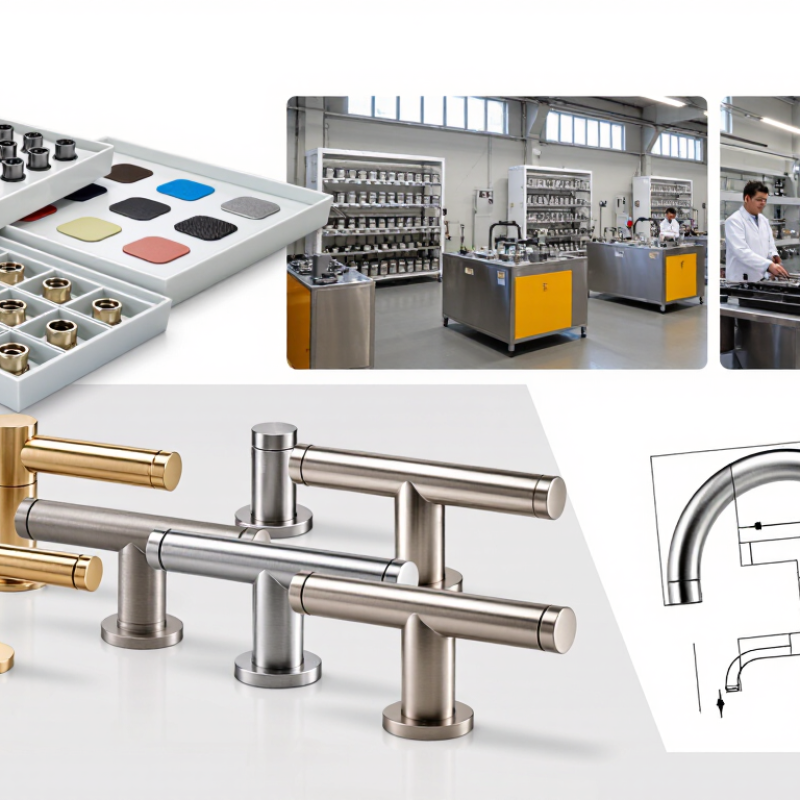
Top Round Faucet Handle Manufacturers for Global Buyers

Round Faucet Handles: Types, Functions, and Common Applications

Round faucet handles combine familiar operation with practical control. Common types include cross handles, lever handles, and rounded knob handles. Cross handles suit traditional bathrooms and require two-handed turning. Lever handles need less grip strength and work well in kitchens, clinics, and accessible washrooms. Knob handles are compact, but wet fingers may slip.

Their main functions include regulating flow, controlling temperature, and supporting cartridge or compression valves. Single-handle designs adjust both settings through one control. Two-handle models separate hot and cold water, making repairs easier in some installations. The U.S. Environmental Protection Agency’s WaterSense program reports that efficient bathroom faucets use no more than 1.5 gallons per minute, compared with the federal standard of 2.2 gallons. That difference matters in hotels, apartment projects, and busy public facilities. However, flow rate alone does not guarantee comfort. Aerator quality, valve durability, and local pressure also influence performance.

Tips: Confirm the mounting-hole layout before ordering. Check thread sizes and water-pressure limits. For international projects, review applicable plumbing standards and temperature-control requirements. Stainless steel or corrosion-resistant finishes usually perform better in humid rooms. Field experience also suggests testing handles with wet hands, not only during factory inspection. A perfect handle does not exist. Some compact designs look elegant but feel awkward after repeated use. Buyers should request sample units, maintenance instructions, and independent test documentation before approving large quantities.

Materials, Finishes, and Design Features to Compare

Top Round Faucet Handle Manufacturers for Global Buyers

Materials, finishes, and design details deserve close comparison when selecting round faucet handle manufacturers. Solid brass offers weight, strength, and dependable thread performance. Stainless steel resists corrosion and suits humid bathrooms. Zinc alloy can reduce cost, but its durability varies by grade and casting quality. Ask suppliers for material declarations, dimensional drawings, and production samples before placing a large order.

Finishes affect both appearance and service life. Brushed surfaces hide fingerprints and minor scratches better than mirror polish. Chrome remains easy to clean and widely accepted across markets. PVD coatings can provide stronger color retention, but quality depends on surface preparation and testing. Matte black looks modern, yet hard-water deposits may become more visible. Request coating thickness data and salt-spray results. A beautiful sample can mislead.

Design features should match the installation environment. Check handle diameter, grip texture, mounting depth, and screw access. A ceramic cartridge connection should operate smoothly without excessive torque. Clear hot-and-cold indicators improve user confidence, especially in rental properties. Standard thread sizes can simplify replacement and reduce service delays. Ask manufacturers to test repeated opening cycles and temperature changes. Small details matter. I have seen buyers focus on color while overlooking loose handle tolerances. That mistake often appears after installation, not during inspection. A pre-shipment inspection with measured samples is worth the extra time.

Key Criteria for Evaluating Global Faucet Handle Manufacturers

For global buyers, evaluating faucet handle manufacturers requires more than comparing catalog prices. Start with material evidence. Ask whether handles use brass, stainless steel, zinc alloy, or engineered polymer, and request composition reports. A polished surface may look impressive. It can still hide weak plating or uneven machining.

Production experience should appear in practical details. Review sample consistency, thread accuracy, edge finishing, and compatibility with common cartridge sizes. Ask for dimensional drawings and tolerance data. Reliable manufacturers usually provide these without hesitation. Factory audits can reveal important facts, including storage conditions, inspection stations, and worker training. A clean showroom is not enough.

Quality control must cover incoming materials, in-process checks, and final inspection. Request test records for corrosion resistance, torque cycles, coating adhesion, and repeated installation. Certification claims should be verifiable through current documents, not screenshots alone. Capacity also matters during seasonal demand. Confirm monthly output, lead times, mold ownership, and backup suppliers for critical components.

Communication is another useful test. Do representatives answer technical questions clearly? Do they report defects honestly? I have found that fast replies do not always mean dependable service. Sample approval, packaging protection, labeling, and spare-part support deserve written agreements. One overlooked carton drop can damage a shipment. Buyers should also test a small order before scaling. This may slow purchasing, but it exposes weaknesses early. No evaluation method is perfect; even a careful audit can miss problems hidden under long-term production pressure.

Top Round Faucet Handle Manufacturers for Global Buyers - Key Criteria for Evaluating Global Faucet Handle Manufacturers

Evaluation Dimension What Global Buyers Should Assess Practical Benchmark or Requirement Recommended Evidence Why It Matters for Round Faucet Handles
Material Selection Confirm the handle body, fixing components, and decorative surfaces are suitable for repeated contact with water, moisture, and cleaning products. Material specifications should identify the alloy, grade, coating system, and corrosion-resistance requirements for the target market. Material declarations, incoming inspection records, coating specifications, and independent laboratory reports where required. Round handles are frequently touched and must maintain structural integrity and appearance throughout normal bathroom or kitchen use.
Dimensional Accuracy Evaluate critical dimensions, mounting interfaces, hole spacing, shaft compatibility, and alignment between the handle and valve cartridge. Critical dimensions should be controlled through approved drawings, gauges, and documented tolerances agreed with the buyer. Technical drawings, first-article inspection reports, calibration records, and batch sampling results. Poor dimensional control can cause loose fitting, difficult installation, misalignment, or incompatibility with the intended faucet mechanism.
Surface Finish Check finish consistency, color uniformity, edge quality, gloss level, and resistance to scratches, tarnishing, and household chemicals. The finish should meet an approved master sample or reference standard and remain visually consistent across production batches. Approved samples, color records, gloss measurements, adhesion testing, and corrosion or chemical-resistance test results. The circular profile makes surface defects, uneven plating, and visible scratches easy for end users to notice.
Mechanical Durability Assess resistance to repeated rotation, tightening, loosening, accidental impact, and normal consumer handling. Testing should follow the applicable faucet or plumbing-product requirements for the destination market and product category. Cycle-test reports, torque-test records, failure analysis, and samples from production rather than development-only units. A handle may become loose, crack, or lose operating control if the body, insert, screw, or connection is not adequately designed.
Quality Management Review whether the manufacturer controls design changes, supplier materials, production processes, nonconforming products, and corrective actions. A documented quality-management system with traceable inspection procedures and controlled production records is preferred. Quality certificates, process-control plans, inspection checklists, audit findings, and corrective-action reports. Consistent process control reduces variation between batches and supports dependable supply for international projects.
Compliance Capability Determine whether the supplier can meet the plumbing, chemical, labeling, packaging, and documentation rules of each destination market. Requirements must be mapped to the importing country, product construction, intended application, and sales channel. Declarations of conformity, test reports from competent laboratories, restricted-substance documents, and labeling samples. A product that passes factory inspection may still be unsuitable for sale if destination-market documentation is incomplete.
Customization and Engineering Assess the ability to modify dimensions, finishes, markings, packaging, and installation components without compromising performance. Changes should be documented through drawings, samples, approval stages, and formal engineering-change controls. Prototype samples, 2D or 3D drawings, revision histories, tooling plans, and pre-production approval records. Round handles often need to match a specific faucet style, mounting system, retail assortment, or architectural project specification.
Production Capacity Verify available machining, forming, polishing, coating, assembly, inspection, and packaging capacity for the expected order volume. Capacity claims should be supported by realistic lead times, production schedules, equipment availability, and peak-season planning. Capacity statements, production plans, equipment lists, staffing information, and historical delivery performance. Insufficient capacity can create delayed launches, partial shipments, and inconsistent quality when orders are accelerated.
Minimum Order Quantity Compare minimum quantities for standard items, customized finishes, special tooling, and private-label packaging. The acceptable quantity depends on tooling, coating batches, packaging requirements, and the buyer’s inventory strategy. Written quotations showing quantity breaks, tooling charges, sample policies, and replenishment conditions. A suitable order structure helps global buyers control inventory risk while achieving competitive unit economics.
Lead Time and Delivery Review sample lead time, production lead time, dispatch readiness, shipment terms, and the supplier’s ability to handle schedule changes. Lead times should be stated separately for samples, tooling, first production, repeat orders, and custom finishes. Order schedules, shipment records, agreed delivery terms, production milestones, and documented delay-notification procedures. Reliable delivery is essential for distributor replenishment, construction schedules, and coordinated faucet-set sales.
Packaging and Export Readiness Check individual protection, carton strength, labeling, moisture control, palletization, and suitability for international transport. Packaging should prevent surface damage, movement, contamination, and mixed-model errors during handling and storage. Packaging drawings, drop-test results where applicable, carton specifications, packing lists, and shipping photographs. Decorative finishes can be damaged by abrasion and impacts even when the handle itself is mechanically sound.
After-Sales Support Evaluate warranty handling, spare-part availability, complaint response, technical communication, and support for installation issues. Responsibilities, warranty periods, response targets, replacement procedures, and claim documentation should be agreed in writing. Warranty terms, service procedures, spare-part lists, complaint logs, and sample corrective-action responses. Accessible support lowers the cost and reputational risk associated with field failures or installation complaints.
Total Cost of Ownership Compare unit price together with tooling, testing, packaging, freight, duties, inspection, defects, warranty exposure, and inventory costs. Supplier comparison should use the same specification, quantity, delivery basis, payment terms, and quality assumptions. Detailed quotations, landed-cost models, defect-rate data, payment terms, and written assumptions for additional charges. The lowest purchase price may not provide the lowest overall cost if quality variation, delays, or returns are high.

Note: Benchmarks should be confirmed against the applicable product standards, building regulations, chemical requirements, and import rules in the destination market.

Leading Round Faucet Handle Manufacturers by Production Region

Round faucet handle manufacturing is concentrated in several production regions, each with distinct strengths. East Asia remains a major supply base for high-volume stamped, forged, and die-cast components. The UN Comtrade database shows strong international trade in metal sanitary fittings under HS 8481, although round handles are not reported separately. This classification limits precise comparisons. Still, it offers a useful regional signal.

European manufacturers generally compete through engineering control, surface consistency, and documented quality systems. Production often includes robotic polishing, salt-spray testing, and tighter dimensional inspection. North American factories tend to support shorter supply chains and customized replacement programs. South and Southeast Asian producers are increasingly attractive for labor-intensive assembly and export-oriented capacity. The International Trade Centre’s trade statistics indicate that sanitary fitting exports are widely distributed, rather than controlled by one region.

Market forecasts also require caution. Grand View Research identifies continuing growth in the global faucets market, driven by renovation, housing construction, and water-efficiency demand. However, faucet handles represent only one component, so applying total faucet figures directly would be misleading. Buyers should request regional production data, monthly capacity, alloy specifications, coating thickness, and sample inspection records. A practical check is simple: measure five handles from one batch, then compare weight, thread fit, and finish under bright light. Cheap pricing can hide inconsistency. Sometimes, the most impressive factory presentation proves very little.

International Buying, Compliance, Customization, and Quality Checks

Top Round Faucet Handle Manufacturers for Global Buyers

International buying starts with more than a catalog and a competitive quote. A reliable manufacturer should provide material declarations, factory details, inspection records, and traceable batch information. Ask whether the handle uses stainless steel, brass, zinc alloy, or engineered polymer. Confirm that the selected material suits potable-water contact and the destination market. Compliance documents must match the actual production model. A generic certificate is not enough.

Request dimensional drawings before approving customization. Check mounting holes, thread sizes, handle height, surface finish, and logo placement. Small differences can create installation problems across regional plumbing systems. Ask for a pre-production sample and compare it with the approved drawing. It sounds basic. It is often skipped.

Quality checks should include torque testing, repeated operation, coating adhesion, corrosion resistance, and visual inspection under bright light. Inspect random units from the finished lot, not only carefully selected samples. Packaging also deserves attention. Foam protection, moisture barriers, carton strength, and readable labels reduce damage during long-distance shipping. Independent laboratory testing adds credibility when market requirements are unclear. Still, paperwork can become outdated. Recheck certificates after material changes, supplier changes, or factory relocation. A flawless sample may hide inconsistent mass production, so ongoing inspections remain necessary. Personally, I would treat an unusually low price as a question, not a saving.

FAQS

What are the common types of round faucet handles?

Cross handles need two-handed turning. Lever handles require less grip strength. Rounded knobs save space, but wet fingers may slip.

What does a round faucet handle control?

It regulates water flow and temperature. Single handles control both settings. Two-handle models separate hot and cold water.

How should buyers check handle compatibility?

Confirm the mounting-hole layout, thread size, cartridge type, and pressure limits. A wrong thread can stop installation immediately.

What flow rate is suitable for efficient bathroom use?

Efficient bathroom faucets often use no more than 1.5 gallons per minute. Comfort still depends on pressure and aerator quality.

Which materials usually perform well in humid rooms?

Stainless steel and corrosion-resistant finishes usually handle humidity better. Brass and zinc alloy can also work, depending on composition and plating.

How can buyers evaluate a manufacturer’s quality?

Request material reports, dimensional drawings, tolerance data, and current test records. Inspect thread accuracy and edge finishing closely.

What factory tests are worth requesting?

Ask for corrosion, coating adhesion, torque-cycle, and repeated-installation tests. Screenshots are not enough. Verify current documents.

Why should buyers test samples before placing large orders?

Small orders reveal inconsistent weight, poor threading, weak finishes, or damaged packaging. This costs time, but hidden defects cost more.

Which production regions may suit different purchasing needs?

East Asia often supports high-volume component production. Europe may emphasize engineering control. North America can support shorter replacement supply chains.

What practical inspection can buyers perform on one batch?

Measure five handles under bright light. Compare weight, finish, and thread fit. Factory presentations can impress. They can still prove very little.

Conclusion

This guide provides global buyers with a practical overview of the Round Faucet Handle market, including common handle types, functions, and applications in residential, commercial, hospitality, and industrial settings. It explains how materials such as brass, stainless steel, zinc alloy, and engineered plastics influence durability, weight, corrosion resistance, and cost. Buyers can also compare finishes, surface treatments, ergonomic shapes, labeling options, and design details to match different faucet systems and interior styles.

The article also outlines key criteria for evaluating manufacturers, including production capacity, process control, customization services, quality consistency, communication, packaging, and delivery reliability. It compares manufacturing regions by their typical strengths and highlights important considerations for international purchasing, such as technical documentation, product compliance, sampling, inspections, and pre-shipment quality checks. By using these criteria, buyers can select dependable suppliers and develop Round Faucet Handle products that meet functional, aesthetic, and project-specific requirements.

Aria

Aria

Aria is a dedicated marketing professional with a deep passion for innovative strategies and a keen understanding of our company's product offerings. With a wealth of experience in the industry, Aria excels at crafting engaging content that highlights the unique features and benefits of our......